
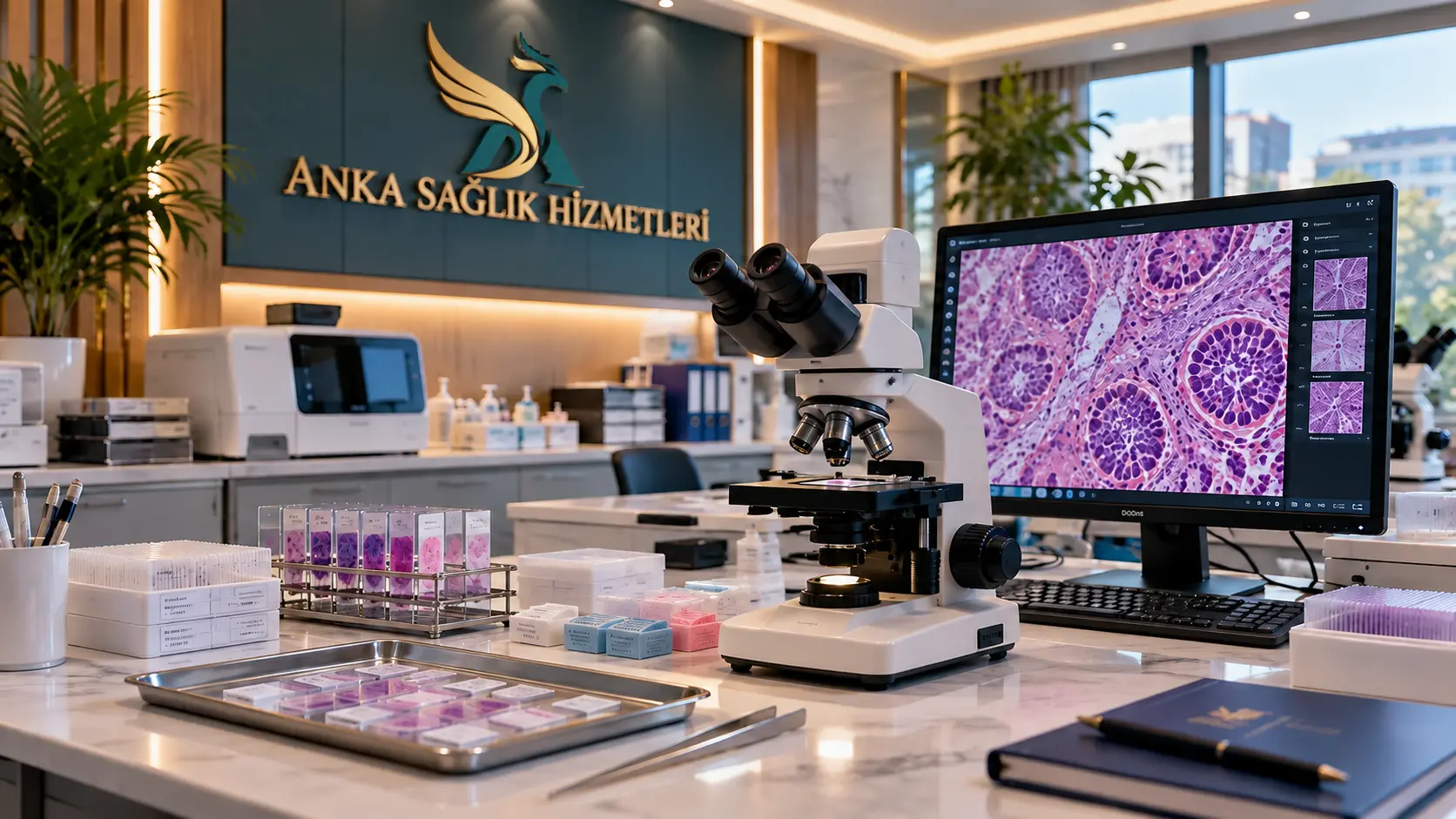
What Is Pathology? Your Guide to Pathology Testing in Ankara
Pathology is the medical field that examines diseases and tissue changes. A pathologist reviews material obtained by biopsy, endoscopy or surgery. Reports range from a short diagnosis to detailed findings about tumor type, margins and biomarkers.
Having a sample sent to pathology does not mean you have cancer. Discuss the report in clinical context with your treating clinician.
The phrase “get pathology testing” usually means laboratory analysis of tissue or cells. Pathology is not an imaging examination such as MRI, ultrasound, CT or PET/CT. Its placement within the radiology section of this website is navigational, not a claim that the two are the same procedure.
Why Is Pathology Requested and Which Diseases Can It Evaluate?
Pathology is not solely a cancer test. It may help identify benign changes, inflammation, infection, polyp types or whether tumor reaches the edges of surgically removed tissue.
- Evaluation of suspicious lesions in breast, thyroid, lung, prostate and other sites.
- Inflammation, polyps and other changes in endoscopic or colonoscopy samples.
- Tumor type, margins and applicable lymph node findings after surgery.
- Selected biomarkers, infection-related or autoimmune tissue findings.
Biopsy vs Pathology: What Is the Difference?
Biopsy is the act of obtaining a specimen; pathology is the examination of that specimen. Surgical tissue can also be sent for pathology, even when the removal was not described as a biopsy.
Biopsy can carry physical risks depending on the procedure. Laboratory study of an existing sample does not itself expose the patient to these procedural risks; specimen identity, adequacy and interpretation are essential.
How Is Pathology Performed? From Specimen to Report
The specimen is collected by the clinical team, labeled and transported appropriately. Many tissue specimens undergo fixation, gross examination, paraffin embedding, thin-sectioning and staining before microscopic review. Some tests require special handling or fresh material, which must be coordinated by the clinical and laboratory teams.
The pathologist may request deeper sections, special stains, immunohistochemistry, molecular analysis or consultation. These steps can increase turnaround time without implying a particular outcome.
- 1Specimen collection
Tissue or cells are collected by biopsy, surgery or another procedure.
- 2Identification and receipt
Specimen details are matched to the patient and source site.
- 3Gross examination
The specimen is described and tissue areas are selected.
- 4Tissue processing
Tissue may be fixed, embedded, sectioned and stained.
- 5Microscopy
A pathologist interprets tissue and cell features.
- 6Additional tests and report
Further tests or consultation may be followed by the report.
Types of Pathology: Histology, Cytology, Frozen Section and Molecular Testing
The types of pathology vary by specimen and technique. The list below describes medical disciplines and does not imply that a particular provider offers every test.
Organ-Specific Pathology: Breast, Thyroid, Lung, Prostate and GI Tract
Patients search for breast, thyroid, lung, prostate and colon pathology results. Although tissue microscopy is common to them, terminology and follow-up differ by organ and disease.
- Breast: lesion type, and when indicated tumor grade, margins and selected ER/PR/HER2 biomarkers.
- Thyroid: Bethesda categories in FNA cytology versus histologic diagnosis after surgery.
- Lung: histologic tumor classification and indicated molecular markers.
- Stomach and colon: endoscopic biopsies, polyps, dysplasia or inflammation.
- Prostate: specific grading such as Gleason/Grade Group where applicable.
How Long Do Pathology Results Take and Why Can There Be Delays?
There is no universal three-day guarantee. Routine cases may finish in a few working days, while complex resections, extra tissue blocks, immunohistochemistry or molecular panels may take a week or two or longer. Frozen section and final permanent-section reports have different timelines.
A report being ready and its explanation by the clinician are separate events. If results are delayed, ask the responsible facility whether the sample was received or additional tests are pending.
How to Read Your Pathology Report
The final diagnosis is often the first section to review. Gross and microscopic descriptions explain how the conclusion was reached. The entire report should be interpreted in the context of the site sampled and the medical history.
| Report section | What it describes |
|---|---|
| Patient and specimen | Identification, date, anatomical source and procedure. |
| Gross description | Visible appearance, size and sections submitted. |
| Microscopic description | Features observed under the microscope. |
| Final diagnosis | The pathologist’s diagnostic conclusion. |
| Grade / staging | Relevant grading or pathological staging elements. |
| Margins / lymph nodes | Margin and node findings where applicable. |
| IHC / biomarkers | Disease-specific additional staining or molecular findings. |
| Addendum | Additional results or clarification issued after initial sign-out. |
Benign, Malignant, Atypia, Dysplasia and In Situ Explained
Benign means noncancerous and malignant means cancerous. Atypia and dysplasia do not automatically mean invasive cancer. Organ-specific grading and risk categories matter; avoid self-diagnosis from one term.
Insufficient material means a reliable diagnosis could not be made from the sample. A negative finding also depends on adequate sampling. Discordance with imaging may prompt review, follow-up or repeat biopsy.
Tumor Grade vs Stage: Why They Are Different
Grade often describes tumor features seen microscopically. Stage describes the anatomical extent of disease and may combine clinical, imaging, surgical and pathology information. Classification is organ-specific.
What Do Margins, Lymph Nodes and TNM Mean?
A surgical margin is the cut edge of tissue. Positive means tumor was identified at an examined edge; negative means it was not. Lymph-node reporting describes whether sampled nodes contain tumor and sometimes their number.
In systems such as TNM, T concerns the primary tumor, N regional nodes and M distant spread. Distant disease cannot always be determined from pathology alone. A pT or pN code is not necessarily the full clinical stage.
Advanced Testing: Immunohistochemistry, FISH, NGS and Molecular Pathology
IHC tests for selected proteins in tissue. FISH detects specified DNA or chromosomal changes; NGS and other molecular methods assess genetic variants. Ordering depends on the diagnosis and clinical purpose.
HER2 and hormone receptors in breast cancer, selected variants in lung cancer, and markers such as PD-L1 may inform care. The same panel is not appropriate for everyone; assay methods and thresholds matter.
Preparation for Pathology: Fasting, Medicines and Previous Reports
An existing block or slide review does not require a new needle procedure, anesthesia or fasting. A newly planned biopsy has its own preparation instructions. Do not stop blood thinners without medical advice.
- Referral and earlier imaging reports.
- Prior pathology reports, slides, paraffin blocks and accession numbers if available.
- Medical history, medications and previous treatments.
- Confirmation of specimen-acceptance and transfer requirements for second opinions.
Are There Risks? Distinguishing Pathology From Biopsy
Analyzing an existing specimen is not another invasive procedure, so it does not cause new needle pain, bleeding or anesthetic risk. Correct identification, sample adequacy, transport and storage still matter.
Biopsy or surgery has different risks, including bleeding, infection or organ-specific complications. Severe bleeding, breathing difficulty or fainting after tissue sampling require urgent assessment; these are sampling-related risks, not pathology-report risks.
Review of an existing specimen is not invasive. Risks of obtaining a new specimen must be discussed separately for the biopsy or surgery.
What Should You Do When Your Pathology Report Arrives?
Do not interpret your entire case by searching one word from the report. Discuss it with the referring clinician alongside examination, imaging and prior results. Ask whether an addendum or molecular test is still pending.
Where results remain uncertain or conflict with clinical findings, specialist review may help. Useful questions include whether the diagnosis is final, whether more tests are needed and when follow-up should occur.
Pathology vs Radiology, Biopsy and Blood Tests
Ultrasound, MRI and CT provide imaging information. Biopsy obtains a specimen. Histology and cytology examine it. Blood tests measure circulating substances or cells. No single test replaces all the others.
Imaging may reveal a mass, whereas pathology can help characterize its cellular or tissue nature. Sometimes imaging is sufficient, and in other cases tissue diagnosis is needed.
| Method | Primary function |
|---|---|
| Ultrasound / MRI / CT | Visualizes a structure or lesion. |
| Biopsy | Collects tissue or cells. |
| Pathology / cytology | Examines tissue or cells in the laboratory. |
| Blood tests | Measures blood cells or substances. |
| Molecular testing | Tests selected biomarkers or molecular changes. |
Pathology Second Opinion: Slides and Paraffin Blocks
A second pathology opinion may be requested for uncertainty or rare diagnoses. Slides, blocks, the first report and relevant clinical records may be needed. Transfer is subject to the originating laboratory’s policies and applicable rules.
A second opinion does not necessarily change the diagnosis; it provides another expert assessment. Clarify how material is transferred and which clinician receives the result.
Ankara Pathology Costs and Insurance Considerations
There is no universal pathology fee. Histology versus cytology, number of samples, slides, immunohistochemistry, molecular testing, second opinions and any new biopsy may change the total.
Insurance coverage depends on provider agreements and policy terms. No unverified prices or contracted coverage are claimed here; confirm an itemized cost and service availability before booking.
Where Can You Get Pathology Testing in Ankara?
In Ankara, pathology is provided by appropriately authorized hospitals and pathology laboratories. You may contact Anka Sağlık Hizmetleri for an inquiry about pathology testing and referral; confirm the actual laboratory address, specimen acceptance and available services before traveling.
For patients from nearby provinces such as Kırıkkale, Kırşehir, Çankırı, Eskişehir, Bolu and Konya, slide and block acceptance, transport requirements, fees and secure report delivery should be confirmed first.
Verify the actual laboratory, address, specialist, specimen acceptance, tests available, handling, reporting and price. No unverified laboratory or equipment claims are made.
How to Inquire About Pathology Services and Results
Before contacting a provider, establish whether a new biopsy is needed or existing material should be reviewed, what organ is involved and whether ancillary tests are requested. Do not transfer specimens without approval and appropriate clinical instructions.
Ask for verified information about the actual laboratory, specimen handling, expected timing and coverage. Contact details on this page are for inquiries and do not guarantee availability at a named pathology laboratory.
Frequently Asked Questions About Pathology
Clear answers about pathology results, procedures, second opinions and inquiries in Ankara.
Request Pathology Information in Ankara
Ask about pathology reporting, existing samples or second opinions. Confirm the actual provider, available tests and costs before arranging specimen transport.
Contact / Inquiry→ ☎ 0538 350 74 45What is pathology and what is it for?
Pathology is the medical specialty that studies disease through tissue, cells and laboratory findings. A pathologist examines biopsy or surgical material and may use extra tests to prepare a diagnostic report.
Are pathology testing and biopsy the same?
No. A biopsy collects tissue or cells, whereas pathology examines and reports on those samples. Surgical specimens or previously collected material may also be analyzed.
Does a pathology referral mean I have cancer?
No. Pathology also investigates inflammation, infections, benign conditions, polyps and many other disorders. A specimen being sent to pathology does not by itself mean cancer.
How long do pathology results take in Ankara?
Turnaround depends on specimen type, workflow and whether extra staining or molecular testing is needed. Some tests finish in days, while complex cases may take one to two weeks or longer. Confirm with the responsible laboratory.
Can I see my pathology result in e-Nabız?
Availability depends on the provider’s system integration and report publication. Contact the responsible facility if it does not appear, and review medical findings with your clinician.
Who writes a pathology report?
The report is issued by a pathologist, a physician trained in tissue and cell diagnosis. The treating clinician integrates it with symptoms and imaging.
What is histopathology?
Histopathology examines tissue architecture and cells within it under the microscope. It is a core method for biopsy and surgical specimens.
What is cytopathology or cytology?
Cytology focuses on cellular features rather than full tissue architecture. Fine-needle aspirates, certain smears and body fluids are examples, with variable adequacy and diagnostic yield.
What does frozen-section pathology mean?
Frozen section provides a rapid intraoperative assessment. It is not used in every operation, and the preliminary finding may be more limited than the later permanent-section report.
How is tissue examined in a pathology laboratory?
The specimen is checked, processed, often fixed and embedded in paraffin, sectioned and stained. A pathologist examines the slides and may order additional tests before reporting.
Do I need to fast for a pathology test?
Reviewing an existing tissue sample generally requires no fasting from the patient. If a biopsy, endoscopy or sedated procedure is planned, follow the instructions for that procedure.
Is pathology testing painful?
Laboratory examination does not cause pain. If a new specimen must be collected, the biopsy or surgery has its own anesthesia and risk considerations.
What does benign mean on a pathology report?
Benign generally means noncancerous. Whether follow-up or treatment is needed depends on the specific diagnosis, location and clinical context.
What does malignant mean in pathology?
Malignant means cancerous. The tumor type, grade and additional test findings require interpretation by the treating team; the word alone does not determine treatment.
Do atypical cells mean cancer?
Atypia describes cells with features differing from normal. It is not automatically cancer and may occur with inflammation, repair changes or precursor lesions.
What is dysplasia and is it cancer?
Dysplasia denotes abnormal cellular or tissue changes. Meaning and management depend on organ and severity; it does not automatically indicate invasive cancer.
What does carcinoma in situ mean?
Carcinoma in situ generally refers to malignant epithelial cells remaining confined without invasion. Clinical meaning and treatment differ by organ.
What does invasion mean on a pathology report?
Invasion describes abnormal cells extending beyond their expected tissue boundary. Extent and type can affect staging and management.
Are tumor grade and stage the same thing?
No. Grade usually describes microscopic tumor features, while stage refers to anatomical extent of disease. Pathology alone may not establish the complete stage.
What does a positive surgical margin mean?
The surgical margin is the cut edge of removed tissue. A positive margin means tumor cells may be present at the examined edge; decisions depend on cancer type and clinical context.
Do negative margins guarantee all disease is gone?
Negative margins indicate no tumor at the examined edge of the specimen. This is important, but does not by itself guarantee that there is no disease elsewhere.
What does a positive lymph node mean?
In an oncology report this often means tumor was found in a sampled lymph node. Location and number of involved nodes matter.
What is the microscopic description?
The microscopic description outlines cellular and tissue findings seen on stained slides. The final diagnosis summarizes their clinical meaning.
What is the gross description?
Gross description records visible features such as size, color and specimen sampling. Appearance by itself does not substitute for microscopic diagnosis.
Why is immunohistochemistry (IHC) done?
IHC uses antibodies to detect proteins in tissue. It can help distinguish tumor types and, in selected diseases, identify treatment-related biomarkers.
What do HER2, ER, PR, Ki-67 and PD-L1 indicate?
These are disease-specific protein or biomarker assessments. Not everyone needs all of them; thresholds and interpretation vary by tumor and method.
Is molecular pathology the same as inherited genetic testing?
Molecular pathology may test genetic changes in a tumor. Somatic alterations in tumor tissue are different from germline testing for inherited predisposition.
Why might NGS be used in pathology?
Next-generation sequencing can assess multiple genomic changes when clinically indicated. It is not required for every case; sample adequacy and laboratory capabilities matter.
What is FISH testing used for?
FISH is a molecular cytogenetic method that detects selected DNA or chromosomal changes in cells. Its use depends on the diagnosis and target alteration.
Does a negative pathology result rule out disease entirely?
Not always. Sampling error, insufficient material or mismatch with imaging or clinical findings may prompt further evaluation.
What does insufficient or nondiagnostic material mean?
It means the sample does not support a reliable diagnosis. It is neither an automatic benign nor malignant finding; clinicians assess whether further sampling is needed.
Why is my pathology report delayed?
Complex samples, deeper sections, IHC, molecular testing, consultation and workflow can add time. Delay does not by itself mean a bad result.
What is a pathology addendum?
An addendum contains additional findings or clarification issued after the initial report. Ask your clinician whether it changes the diagnosis or plan.
Can I request a second pathology opinion?
Yes. Slides, paraffin blocks and reports may be reviewed by another pathologist through an appropriate transfer process. Ask the original laboratory about its release and archival rules.
Why are pathology slides and paraffin blocks stored?
They may support re-review, second opinions or additional testing. Storage and release depend on the laboratory and relevant regulations.
Can treatment start before the pathology report is final?
Only the treating team can decide. Some urgent conditions require action before full results, whereas many treatments depend on final pathology and biomarkers.
What does a polyp pathology result mean?
Polyp describes a growth from a lining. Histology may show different types, and follow-up depends on organ and subtype.
What can be included in breast pathology?
Depending on the case, breast pathology may include benign findings, tumor type and grade, and selected ER/PR, HER2 and other markers.
What does Bethesda mean in thyroid cytology?
Bethesda is a categorical system used in thyroid fine-needle cytology. The next step also depends on ultrasound and clinical context.
Is a cervical smear a pathology test?
Cervical cytology is a cell-based laboratory examination. It may be paired with HPV testing, but screening results are not identical to tissue histology.
Can pathology detect infection or fungi?
Selected tissue tests can reveal organisms or inflammation. Culture and additional microbiology tests may still be needed.
What does pathology cost in Ankara?
Fees vary by specimen and number of samples, IHC, molecular tests, second opinions and coverage. Ask for a verified itemized estimate.
Will insurance cover pathology testing?
Coverage depends on referrals, provider contracts, policy terms, additional tests and authorization. Confirm with the insurer and actual laboratory.
Where can I get pathology testing in Ankara?
Pathology examinations are provided by appropriately authorized hospitals and laboratories. Ask Anka Sağlık Hizmetleri about the process, but confirm the actual laboratory, address and service availability.
Can patients from provinces near Ankara request pathology services?
People traveling from nearby provinces can inquire. Confirm whether a new specimen is needed, whether blocks/slides are accepted and how transport and reporting work.
Can I share my pathology report with another doctor?
Subject to consent and privacy rules, a report can be shared with clinicians. Second opinions may also require the physical slides or blocks.
Do I need an appointment for pathology results?
The referring doctor commonly reviews the report with you. Appointment requirements for specimen submission or second opinion vary by provider.
What should I do after pathology testing?
Testing an existing sample requires no physical recovery by the patient. Follow separate biopsy or surgery instructions and discuss findings with your clinician.
References and International Medical Sources
- National Cancer Institute (NCI): Pathology reports
- College of American Pathologists: How to read a pathology report
- American Cancer Society: Understanding pathology reports
- Cleveland Clinic: Pathology report
- NCI: How cancer is diagnosed
- NCI: Biomarker testing for cancer treatment
- NCI: Cancer staging
- NHS: Biopsy and results
- MedlinePlus: Understanding lab results
- NCI/SEER: Pathological exams and staging
- Cancer Research UK: Biopsy
This content is educational; it does not replace individualized diagnosis, physician consultation, an official pathology report or medical treatment advice.